Home furnishings · Room planning
A Practical Guide to Choosing Modern Pieces for Your Home
Modern furniture can make a room feel clearer, calmer and more useful. But a clean silhouette is only the beginning. The right choice also has to fit through the door, leave room to move, withstand daily routines and earn its place over time.
“Modern” is often used as shorthand for furniture with simple lines and little ornament. That description can be useful, but it is not a complete buying guide. A spare-looking piece may be poorly suited to a busy household; an elegant table may crowd a narrow dining area; a handsome finish may demand more care than its owner can reasonably provide. Style matters, but the practical questions are what turn a promising design into a good decision.
For U.S. homes, where room sizes, floor plans and household needs vary widely, choosing modern furniture is a matter of matching appearance to evidence. Measure the space. Examine the materials and construction. Consider who will use the piece, and how often. Then judge whether its proportions and care requirements make sense for the life already taking place in the room.
This approach applies to a first apartment as much as a long-term home. It can help renters working around fixed layouts, homeowners furnishing an open-plan space, and anyone trying to make a considered purchase without relying on a product photograph alone. The goal is not to make every room look alike. It is to choose pieces that feel coherent while performing their everyday jobs.
Start with the room, not the product
Furniture shopping tends to begin with an object: a sofa, a dresser, a bench. Room planning begins with the space around it. Before comparing finishes or styles, take an accurate inventory of the room and the routes people use through it. A beautiful object that obstructs a doorway or interrupts a regular path is not a successful fit.
Measure the room’s length and width, then note its fixed features: doors and the direction they swing, windows, radiators, vents, outlets, fireplaces and built-in storage. Identify where people enter and where they need to go. In a bedroom, that might mean the bed, closet and dresser. In a dining room, it includes the table, kitchen access and room to pull out chairs. For a living area, consider the paths between seating, entry points and adjacent spaces.
Record measurements in inches, and keep the notes where you can consult them while comparing furniture. If you are measuring a piece at home, include its full outside dimensions—width, height and depth—not just the space it occupies on a product page. The depth of a sofa, for example, affects how much floor space remains between its front edge and a coffee table. The height of a dresser matters if it must sit under a window or shelf.
Do not stop at the room. Measure the route from the building entrance to the final destination. Doorways, stairwells, elevators and tight hall corners can pose a more difficult problem than the room itself. Check the size of the largest fixed part of the item, and ask whether removable legs or other components change the delivery dimensions. If a piece must be carried upstairs, the turning space at each landing deserves attention.
Think in clearances and movement
A floor plan can reveal whether furniture fits on paper. A little extra thought reveals whether it works in practice. Place temporary outlines on the floor with painter’s tape or newspaper, using the item’s stated dimensions as a guide. Live with the outline for a while. Walk around it. Open doors and drawers. Pull out a dining chair. Notice whether the remaining space feels easy to use or merely technically passable.
There is no single clearance that suits every room, because household habits and mobility needs differ. Instead, treat clear space as part of the design. A frequently used route should feel natural, without forcing people to turn sideways or step around a sharp corner. A drawer needs room to open and a person needs room to stand in front of it. A dining chair needs space behind it when someone is seated and when they are getting up.
For a small room, restraint can be more useful than miniaturizing everything. A single well-proportioned storage piece may be easier to live with than several small objects that break up the floor. A bench can offer flexible seating where chairs would complicate circulation. At the same time, a piece that is too small may look adrift and provide too little function. The question is not simply “Will it fit?” but “Will the room still work after it arrives?”
In open-plan interiors, use furniture to define zones without creating unnecessary barriers. A table, sofa or bench can mark a change in use while preserving sightlines and movement. Keep the proportions connected: a small table beside a very deep sofa may feel awkward, while an oversized item can dominate the shared area. A quick scaled sketch—one square per foot, for instance—helps compare arrangements before anything is moved.
Choose proportions for the people using them
Modern furniture is sometimes described as if appearance alone determines comfort. In daily life, proportions do more of the work. Seat height and depth, back support, table height, reach and storage access all shape the way a piece serves its users. These details deserve attention before a design is chosen for its finish or profile.
For seating, consider how people will use it and for how long. A bench at a dining table may be convenient for a flexible household, but check that its height works with the table and that everyone can sit comfortably. A stool intended for a counter should match the counter’s height and leave enough space for knees. For a desk chair, look for a position that lets the user sit with feet supported and shoulders relaxed; a chair that appears streamlined but cannot be adjusted may be a poor fit for extended work.
Bedroom storage calls for its own practical test. Can drawers be opened fully without hitting the bed? Is the top surface at a useful height? Will the piece hold the belongings it is meant to organize? A tall chest may make better use of a compact footprint, while a wider dresser may provide easier access and a broader surface. Household needs, not a label such as “modern,” should settle the choice.
When possible, try furniture in person. Sit for more than a moment. Reach for a drawer pull. Check whether the edges, arms and back support feel comfortable. If you are buying remotely, look for complete dimensions and ask for details not provided. A product’s overall height does not tell you the seat height; a stated dresser width does not explain drawer depth. Those distinctions can matter once the piece is part of the room.
Read the materials beyond the name
Material descriptions can sound reassuring while leaving key questions unanswered. “Wood,” “performance fabric” and “natural finish” are broad terms, not full explanations of how an item is made or maintained. Ask what the main components are, how surfaces are finished, and whether the maker provides care guidance. These answers offer a more useful basis for comparison than a material label alone.
Solid wood, engineered wood and veneers each have different characteristics. Solid wood is milled from lumber and can display variation in grain and color. Engineered wood uses bonded wood fibers, strands or layers; its properties depend on the product and construction. A veneer is a thin layer of real wood applied over a core, which may be solid wood or an engineered panel. Veneer is not automatically a sign of poor quality, just as solid wood alone does not guarantee sound design. Joinery, thickness, support and workmanship matter too.
Wood also responds to its environment. Changes in humidity and temperature can affect it, and direct sunlight may alter its color over time. A finish influences appearance and care, but “eco-friendly” is not a universal performance specification. If environmental attributes are important, ask what the claim means, what materials or processes it refers to, and whether supporting information is available. Avoid assuming that a particular finish is maintenance-free.
For upholstered furniture, ask about the cover fabric, cushion construction and cleaning instructions. Consider whether the material is exposed to pets, children, sunlight or frequent spills. A fabric that looks refined in a showroom may require more careful upkeep than a household can sustain. For tables and case goods, think about how often surfaces will be handled and what cleaning products are appropriate. Clear care instructions help protect both appearance and useful life.
Look for construction that suits everyday use
Construction is easier to appreciate when you translate it into questions about use. Does the frame feel stable? Are the drawers supported and easy to operate? Do doors stay aligned? Are the joints and connections appropriate for the loads the piece is expected to carry? The answers depend on the object, but they are more revealing than a broad promise of durability.
With a table or bench, inspect how the legs connect to the frame and whether the piece wobbles on a level floor. With a dresser, open and close each drawer, paying attention to how it moves when lightly and more fully loaded. Ask whether drawer boxes, slides and hardware are described, and whether components can be adjusted or replaced. For a bed, confirm that the mattress dimensions match the frame and that the support system is specified. A modern profile can look deceptively simple; its performance still depends on sound structure.
Details such as a dovetail drawer joint or an oil-and-wax finish can help describe a product, but they should not end the inquiry. Ask how the feature affects the particular piece, whether it is used throughout or only in certain areas, and what care it requires. A piece’s origin and how it is made may also matter to a buyer, but should be understood as part of the overall assessment rather than a substitute for checking dimensions, materials and function.
Consider how the furniture may need to change with the household. A flexible bench can move between dining and entryway use; modular storage may adapt as needs shift. Yet versatility is valuable only when the piece performs each intended role well. A realistic list of uses helps distinguish genuine flexibility from a feature that sounds useful but is unlikely to be used.
Use finish and color to build continuity
A modern room does not need a matching set. In fact, repeating one finish everywhere can make a space feel flat. A more considered approach is to establish a few points of connection: related wood tones, repeated metal details, a shared color family or a consistent level of visual simplicity. This creates coherence without making every item identical.
Natural wood varies, even within a species. Cherry, maple and walnut differ in color and grain, and pieces made at different times may not be exact matches. Compare samples in the room’s actual light if possible. Daylight, warm bulbs and reflected color from walls can change how a finish appears. Consider the direction of the grain and the scale of visible pattern as well as the basic hue.
Finishes also determine how a piece meets its surroundings. A pale, low-profile object may feel visually lighter than a dark, substantial cabinet of the same dimensions, but the floor space they occupy does not change. Color can influence perception; it cannot correct a layout that is physically too crowded. Make the room plan work first, then use finish and form to shape its mood.
Before settling on a finish, consider how the room is used. High-traffic spaces may call for surfaces that are easier to clean, while rooms with direct sunlight may need thoughtful placement to limit fading. Ask whether marks can be refreshed and what routine care involves. A finish that looks good on delivery but is difficult to maintain may be less suitable than a quieter option designed for everyday handling.
Consider a piece in context
A useful way to assess modern furniture is to compare the design idea with the tasks it must handle. A clean-lined bench, for example, can serve as dining seating or an entryway landing place, provided its dimensions and stability suit that role. The Modern American Bench is described as a solid-wood piece made in Vermont, offered in cherry, maple or walnut with an oil finish. Those details provide a starting point for practical questions: What are its exact dimensions? How does its height work with the intended table? What care does the finish require?
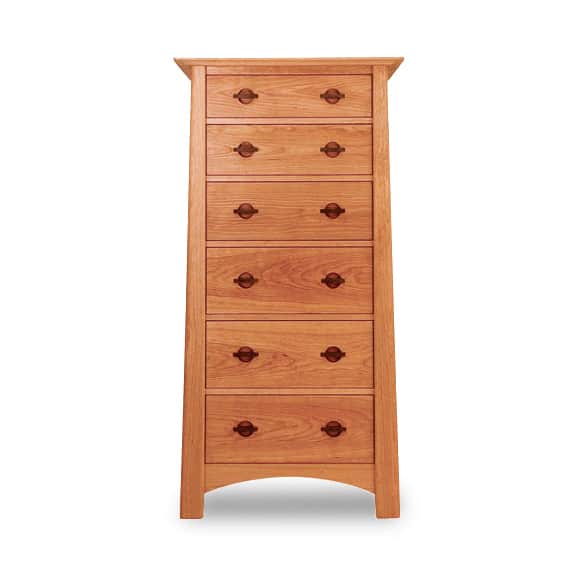
In a bedroom, storage should be judged by access as much as capacity. A piece with several drawers may organize belongings effectively, but only if its size leaves room to open them and its arrangement matches what the household stores. The Modern American 9-Drawer Dresser is described as handmade in Vermont from solid cherry or walnut with an eco-friendly oil finish. Before choosing any dresser, verify its measurements, drawer configuration, delivery path and care instructions rather than relying on the number of drawers or style description alone.
These examples illustrate a broader principle: product descriptions are useful prompts, not a substitute for fit and verification. Confirm specifications with the retailer or maker, especially when a piece is built to order or has a stated crafting time. Ask which options are included, what can be customized, what delivery entails and how the item should be maintained. Written answers can make comparisons clearer and reduce surprises after purchase.
Make delivery, assembly and care part of the decision
The cost and effort of furnishing a room do not end at the purchase. Delivery arrangements, assembly, packaging removal and ongoing care all affect whether a piece is convenient in practice. Before committing, find out what delivery service includes. Is the furniture brought into the room, left at the entrance or delivered to the curb? Is assembly included? What happens if a delivery team cannot navigate the route?
For made-to-order furniture, clarify estimated timing and what happens if production or delivery is delayed. Confirm the return, cancellation and damage policies before placing an order. U.S. consumer protections and policies can vary by transaction and seller, so read the terms that apply to the specific purchase rather than assuming every retailer uses the same rules. Keep copies of order details and care information.
Maintenance belongs in the decision as well. Find out whether a wood surface should be dusted dry, cleaned with a damp cloth or treated with a particular product. Ask how spills should be handled and whether the finish can be renewed. For upholstery, check whether the cover is removable and what cleaning methods are recommended. The simplest routine is often the one a household will actually follow.
Durability is not only a question of how long an object survives. It also involves whether it remains useful, repairable and compatible with changing needs. A piece built from substantial materials may still be inconvenient if it cannot be moved, repaired or adapted. Conversely, a modestly scaled item may offer years of service because it fits its role well. Think in terms of useful life, not just initial impression.
A practical checklist before you decide
When comparing options, use the same questions for each one. A consistent checklist reduces the temptation to judge one piece by its appearance and another by its price or materials alone.
- Room fit: Have you measured the room, doorways and delivery route?
- Movement: Can people walk through, sit down, open drawers and use nearby doors without obstruction?
- Purpose: Does the piece suit the task, users and frequency of use?
- Proportion: Are its height, depth and scale right for the surrounding furniture?
- Materials: Are the main materials and surface finish clearly described?
- Construction: Do you understand the frame, joinery, supports and hardware relevant to the item?
- Care: Are cleaning and maintenance requirements realistic for your household?
- Delivery: Are timing, assembly, placement and damage procedures clear?
- Terms: Have you read the return, cancellation and warranty information that applies?
- Long-term use: Is the piece likely to remain useful if your room or needs change?
If an answer is missing, pause and seek clarification. That is not hesitation for its own sake; it is a straightforward way to reduce uncertainty. A carefully measured room and a clear understanding of the product will usually tell you more than another hour spent scrolling through similar silhouettes.
Modern means considered, not merely minimal
Modern furniture is often associated with clean lines, restrained detailing and practical proportions. But a home does not become more functional simply because its furnishings look streamlined. Good choices reconcile visual clarity with the demands of real life: a drawer that opens fully, a seat that suits its users, a finish that can be cared for, and a scale that lets the room breathe.
Begin with measurements. Test layouts before buying. Compare materials and construction in plain terms, and ask how a piece will be used on an ordinary weekday—not only how it will look when the room is newly arranged. Consider delivery and maintenance alongside style. These habits make a furniture decision less about following a trend and more about understanding the object.
The best modern pieces do not insist on attention. They help a room function, contribute to its character and remain useful after the novelty of purchase has passed. When scale, materials, construction and daily use are considered together, a streamlined design can offer more than a polished appearance: it can become a dependable part of home life.